But here's what no one puts in the brochure: consignment doesn't remove the supply chain from your project. It just moves it into your office.
| Dimension |
Turnkey |
Consignment |
| Who buys? |
Us |
You |
| Who owns shortages? |
Us |
You |
| Who deals with counterfeit risk? |
Us |
You |
| Who pays for MSD damage from bad packing? |
Us |
You |
| Your time per project |
~1–2 hrs (review, approve) |
10–25 hrs (source, inspect, ship, chase) |
| Assembly defects |
Us |
Us |
| Component defects |
Us |
You |
| One invoice |
Yes |
No (you pay vendors + us) |
| Best for |
Speed, small teams, standard BOMs |
Existing stock, strict sourcing, mature teams |
On paper, consignment wins. You skip the 8–12% markup. You use your $1,300 reel instead of our $1,500 one.
Then you pay yourself. A typical 500-board run, ~150 components:
Sourcing and POs: 12 hours × $90/hr internal eng/procurement cost = $1,080
Incoming inspection at your dock: 3 hrs = $270
Packing, labeling, shipping to our line: $150
Slack you build into inventory "just in case": ~$400
One shortage that stalls production for 3 days: hard to price, but real
Turnkey on that same build: $1,500 for parts + build. No internal hours. No "just in case" buffer. Done in 3 weeks instead of 7.
We've watched consignment "save" $200 on paper and burn $3,000 in hidden cost and two months of calendar time. Not because the model is bad—because the math is incomplete.
Consignment is only cheaper when your procurement is already paid for, your stock already exists, and your risk tolerance is high. If you have to hire or divert people to make it work, you're not saving money. You're subsidizing your PCBA with your own payroll.
What Actually Breaks in Consignment?
1. The missing 180-piece shortfall
You ordered 5,000. They shipped 4,820. Now the line waits for you, not us.
2. Moisture-sensitive parts in a Ziploc
If it's not in proper MSD packaging, we'll flag it. If you tell us to run it anyway and it pops in reflow, that's your warranty claim, not ours.
3. "This is not the failure we expected"
Field failure traced to a customer-supplied batch? You own the replacement, the rework, and the freight both ways.
4. The BOM you didn't want us to see
Fair. But if IP is the reason for consignment, you're already paying a premium for that privacy. We don't care either way—we just want the parts to be real.
Partial Turnkey
Most of our long-term customers don't pick a side. They split the BOM.
You give us the sensitive stuff: the radio, the MCU, the obsolete part you hoarded. We buy the rest—the 200 resistors, caps, connectors, LEDs, passives.
Why this works:
You keep control where it matters.
You don't spend 6 hours sourcing 10k 0603 resistors.
We still own the bulk of the risk and timeline.
One PO, one delivery, no drama.
If you're sitting on inventory but don't want to run the whole show, this is usually the right answer. We'll even help you decide what's worth keeping and what's not.
How to Actually Decide?
Don't ask "which is cheaper." Ask these:
Pick turnkey if:
You have no dedicated buyer
Time-to-market is tight
Your BOM is mostly catalog parts
You'd rather not think about reels and MSD labels
You want one throat to choke (ours)
Pick consignment if:
You have real inventory to burn
You've got 10–20% better pricing than we do
You must control lot traceability for compliance
You already have a buyer whose time is budgeted
You've been burned before and want to see every part yourself
Pick partial turnkey if:
You like the idea of turnkey but not the idea of giving us everything
You have 3–5 "must control" lines on the BOM
You want to move fast without moving recklessly
Why We Don't Push One Model?
We've got the equipment either way. SMT, THT, AOI, X-ray, functional test—all in-house at our production line. We'll take your parts, we'll buy your parts, or we'll split them down the middle.
What we won't do is pretend one size fits every project. Some customers need speed. Some need audit trails. Some need to use the 5,000 ICs they bought in 2022 before the price tripled. All of it is valid.
We do a free DFM review on every order, regardless of sourcing. We 100% inspect. We tell you if your consignment parts look dodgy before we put them on a board. And if you want, we'll quote the same project three ways and let you decide what your time, risk, and budget are worth.
FAQ
1.Is turnkey just a markup play?
It's a markup for service and risk. You're not paying for the parts. You're paying not to be the one on the hook when the parts don't show.
2.Do you use authorized distributors only?
For turnkey, yes. If you want us to buy elsewhere, we'll tell you why we don't.
3.Can I do partial turnkey with just one or two lines?
Yes. We've done 90% us / 10% you. We've done the reverse. We'll make the split work.
4.What about prototypes?
Turnkey prototype: 3–5 days if the parts are available. Consignment prototype: add 1–2 weeks for you to source and ship. If you're in a rush, that math usually decides it.
5.What if I'm a startup?
Most startups should do turnkey until they have inventory, leverage, and a reason not to. You're not saving money by turning your CTO into a parts buyer.
What to Do Next?
Send us your Gerber and BOM. That's it.
We'll look at it, split it three ways if it makes sense, and send back a short note with:
What each model costs (real total, not just the line items)
What each model risks
What we'd do if it were our own board
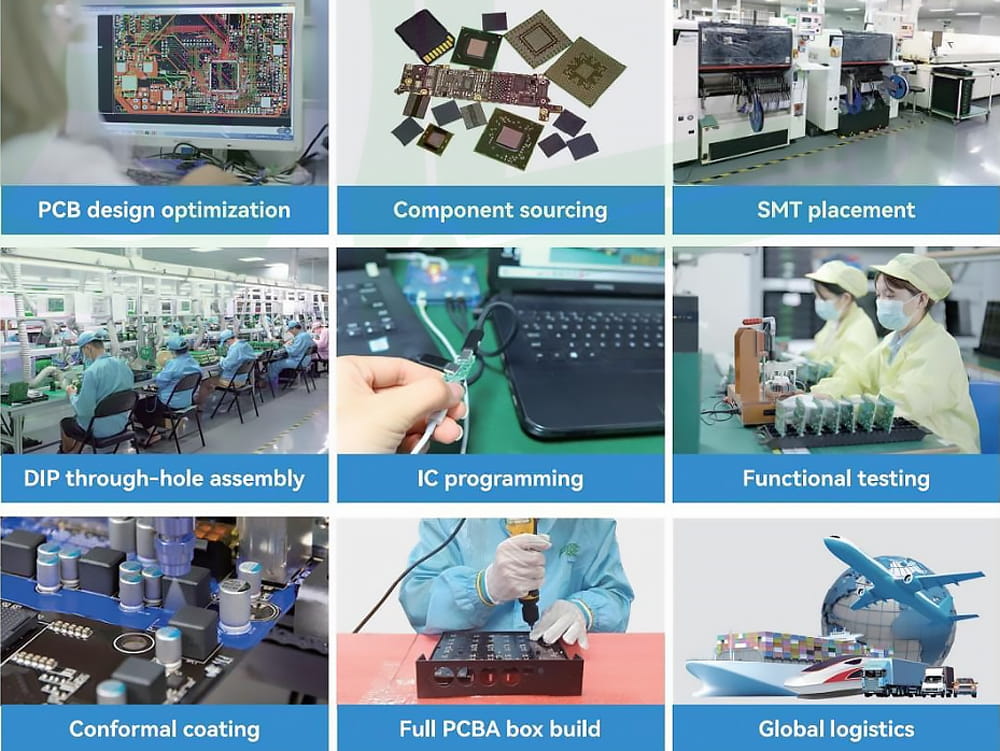
POE builds PCB assembly the way you actually need it—turnkey, consignment, or the messy middle. All from our own production line, with full test and full accountability. Send your files when you're ready.

 Email: all@poe-pcba.com
 Whatsapp: 85292069596
 Tel: 0755-25312250/ +8613798543496
 Factory Address: Floor 3, Jinyuan Industrial Park, No. 56, Tangtou Avenue, Shiyan Town, Baoan District, Shenzhen China





