IPC-A-610 PCB Assembly Quality Standards
If you buy or approve PCB assemblies, IPC-A-610 is the one document that should sit on every desk in your supply chain. It is the industry's constitution for what "good" actually means after a board leaves the oven.
What is IPC-A-610?
IPC-A-610, Acceptability of Electronic Assemblies, is the most widely referenced visual inspection standard in electronics manufacturing. It defines, in exact visual and dimensional terms, whether a finished PCBA passes or fails.
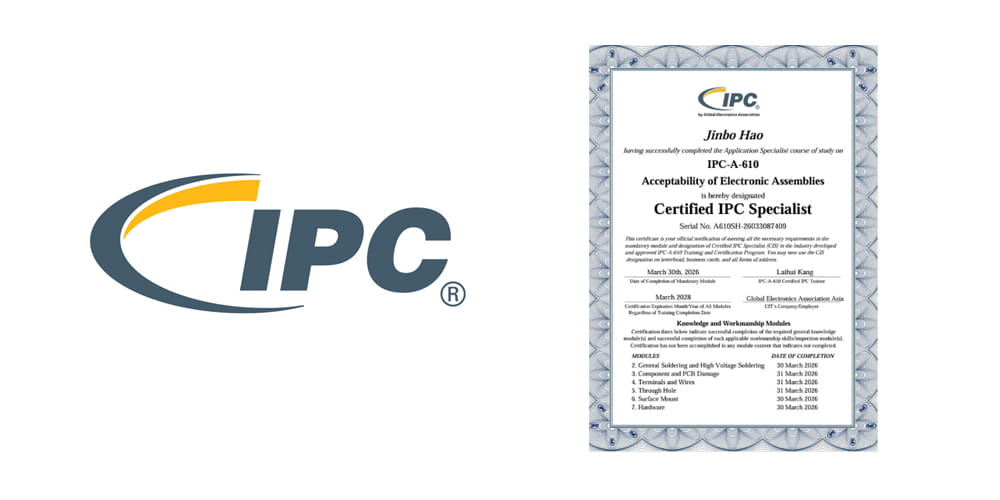
First published: 1983
Current revision: IPC-A-610J, March 2024 (supersedes Revision H)
Scope: 450+ pages, 800+ full-color images, developed with input from 31 countries
Coverage: solder joints, component placement, mechanical assembly, cleanliness, coating, marking, and physical damage
Note: There is no Revision I. IPC skips "I" to avoid confusion with the numeral 1 and lowercase "l".
In practice, IPC-A-610 is the single source of truth for acceptability—from solder fillet geometry to pad overhang limits to post-assembly cleanliness. When a contract says "built to IPC-A-610," this is the book being opened on the inspection bench.
IPC-A-610 vs. J-STD-001 vs. IPC-A-600
These three standards are often mentioned together, but they do different jobs.
| Standard |
What It Covers |
Role |
| IPC-A-610 |
Acceptability of assembled PCBs |
The "what does good look like" for finished boards |
| J-STD-001 |
Soldering process & material requirements |
The "how to solder" rulebook |
| IPC-A-600 |
Bare board (unpopulated PCB) acceptability |
The quality gate before components go on |
J-STD-001 tells the line how to solder. IPC-A-610 tells the inspector what to accept. IPC-A-600 qualifies the raw board. They are cited together in professional RFQs for a reason: process compliance means nothing without acceptance criteria, and vice versa.
The Three-Class System: Class 1, Class 2, and Class 3
IPC-A-610's classification system exists because reliability is not one-size-fits-all. The three classes trade off workmanship stringency against cost.
Class 1 — General Electronic Products
Function is the priority. Appearance is secondary.
Typical use: toys, remote controls, promotional electronics, short-life IoT devices
Inspection posture: generous tolerances; incomplete wetting is acceptable if the joint conducts
Cost: baseline, lowest manufacturing overhead
Example: a chip resistor with 50% pad wetting that would be rejected in Class 3 is accepted in Class 1, provided it tests electrically.
Class 2 — Dedicated Service Electronic Products
Reliable performance over time, without catastrophic failure.
Typical use: industrial controls, telecom infrastructure, commercial equipment, automotive non-safety systems, test & measurement
Market reality: ~70% of global PCB assemblies default to Class 2 when no class is specified
Inspection posture: balanced; quantified solder fillets, tighter placement tolerances, statistical sampling allowed
Cost: reference baseline for professional electronics
This is the workhorse class—reliable enough for years of service, economical enough to scale.
Class 3 — High-Performance / High-Reliability Electronic Products
Failure is not an option.
Typical use: aerospace avionics, military systems, medical life-support, automotive safety, space electronics
Inspection posture: 100% visual inspection, strict documentation, near-zero deviation tolerance
Cost impact: +20% to +40% over Class 2, driven by slower throughput, higher rejection, and full traceability
In Class 3, a "process indicator" in Class 2 becomes a defect. There is no middle ground.
IPC-A-610 Class 2 vs. Class 3
| Criterion |
Class 2 — Dedicated Service |
Class 3 — High Reliability |
| Intended use |
Continued service desired; occasional failure tolerable |
Performance-on-demand; failure unacceptable |
| Reliability target |
Long, dependable service |
Maximum reliability in harsh environments |
| Inspection |
Statistical sampling allowed |
100% visual inspection required |
| Through-hole solder fill |
≥50% of barrel height |
≥75% of barrel height |
| SMT chip component side overhang |
≤50% component width |
≤25% component width |
| Circular wetting (terminations) |
≥180° |
≥270° |
| Termination width coverage |
≥50% |
≥75% |
| Annular ring (plated holes) |
Reduced ring/breakout may be allowed |
Minimum annular ring required; no breakout |
| BGA voiding |
Less stringent |
≤25% total area; core stress zone restricted |
| Cost impact |
Baseline |
+20–40% |
The reverse is not true.Key Inspection Areas Covered by IPC-A-610
1. Soldering Requirements (Through-Hole and SMT)
Complete wetting, no bridging
Controlled solder volume, smooth concave fillets
No cracks, fractures, or dewetting
Through-hole joints meet barrel fill targets per class
SMT joints show stable, documented wetting geometry
2. Component Placement and Orientation
Correct polarity and reference alignment
Pads fully engaged within tolerance
No interference with adjacent features or inspection access
Lead trimming and clinch within spec
3. Mechanical Assembly and PCB Integrity
Fasteners torqued and locked
Heat sinks and hardware installed per drawing
PCB warpage within defined limits
No delamination, measling, or laminate damage
4. Cleanliness and Contamination Control
No residues that threaten electrical performance
Ionic contamination ≤1.56 μg NaCl eq./cm² (IPC-TM-650 2.3.25)
No visible flux residues (no-clean residue is explicitly acceptable)
Cleaning processes verified to avoid component damage
5. Conformal Coating and Staking
Uniform coverage, no bridging or pooling
Proper masking of keep-out areas
Adhesion and cure validated
IPC-A-610J: What Changed in 2024
| Change |
Description |
| "Target" condition removed |
All conditions now classified as Acceptable, Process Indicator, or Defect |
| QFN/DFN side wall wetting |
Class 3: side fillet must reach ≥75% of pin thickness |
| BGA voiding – core zone |
Class 3: voids in 20% stress zone may be rejected even if total void ≤25% |
| Measling / delamination |
Any thermal-stress-induced separation is a Class 3 defect |
| Conformal coating |
Expanded guidance on voids, bubbles, coverage |
| Cleanliness criteria |
Updated for modern no-clean flux chemistries |
| Visual references |
Substantially expanded imagery for consistent interpretation |
For Class 3 programs, the practical effect is simple: fewer gray areas, more rework, and higher confidence in field performance.
IPC-A-610 Certification: CIS and CIT
| Certification |
Audience |
Pass Score |
Validity |
| CIS – Certified IPC Specialist |
Inspectors, operators, QE |
70% (open book) |
2 years |
| CIT – Certified IPC Trainer |
Internal trainers |
80% |
2 years |
A factory with active CIS-certified inspectors has at least made the investment to speak the same language as your quality team.
How to Choose the Right IPC-A-610 Class for Your Product?
Use the lowest class that satisfies your real reliability requirement.
Class 1: disposable, short lifecycle, cost-driven, failure = inconvenience
Examples: toys, promotional electronics, basic consumer devices
Class 2: default for most commercial/industrial programs; failure is undesirable but not life-threatening
Examples: industrial controllers, telecom gear, automotive non-safety modules
Class 3: failure = loss of life, mission failure, or regulatory breach; harsh environment, zero tolerance
Examples: pacemakers, flight controls, defense systems, spacecraft
Over-specifying Class 3 on a Class 2 product adds 20–40% cost with no return on reliability.
How to Verify Your PCB Assembly Partner Follows IPC-A-610?
These five checks remove ambiguity from your supply chain:
Specify the revision. Write "IPC-A-610J Class 2" on the PO and RFQ. Standards change; acceptance criteria change with them.
Ask for CIS proof. Request current certificates for the inspectors assigned to your line.
Review inspection artifacts. AOI/SPI reports, X-ray for BGAs, cleanliness test results, first-article inspection records.
Check quality metrics. First-pass yield, PPM defect rate, non-conformance handling, and traceability depth.
Audit if Class 3. Verify cleanroom status (if required), AOI/X-ray capability, and documented training records.
Why POE for Your IPC-A-610 Compliant PCB Assembly?
POE is a PCBA manufacturer that builds to the standard—not around it.
IPC-A-610J implemented in full, including 2024 updates and revised Class 3 criteria
CIS-certified inspection team, trained on J revision, re-certified every 24 months
Class 1 / 2 / 3 capability, matched to your product's actual reliability need
100% AOI coverage; Class 3 orders receive full 100% visual inspection
AOI with J-revision algorithms + X-ray for BGA and QFN verification
Ionic cleanliness testing per IPC-TM-650 2.3.25 on request
Complete traceability for every board, component lot, and inspection result
DFM review included on every new project to align class, cost, and yield before the first panel runs
Whether your next build is Class 2 industrial control or Class 3 implantable-adjacent electronics, the acceptance criteria are the same: what passes is what the standard says passes.
FAQ
What is IPC-A-610?
The global visual acceptance standard for finished PCB assemblies, covering solder, placement, cleanliness, and more.
What is the current revision?
IPC-A-610J, released March 2024.
Which class should I choose?
Class 1 for disposable consumer; Class 2 for most commercial/industrial; Class 3 for medical, aerospace, defense, and safety-critical.
What changed in Revision J?
Removal of "Target," tighter Class 3 QFN wetting and BGA void rules, zero tolerance for measling in Class 3, expanded coating and cleanliness guidance.
Does IPC-A-610 require 100% inspection?
Only Class 3 mandates 100% visual inspection. Class 2 allows statistical sampling.
How do I confirm my supplier is compliant?
Specify the revision, verify CIS certification, review inspection reports, and confirm traceability.
Ready to Start Your IPC-A-610 Compliant PCB Assembly Project?
Define the class. Demand the documentation. Build with a partner who actually uses the book.
Send us your design files and quality requirements. POE will return a DFM review, confirm your IPC-A-610 class, and issue a fixed-price quote within 24 hours—so you know exactly what you're buying before the first board is placed.

 Email: all@poe-pcba.com
 Whatsapp: 85292069596
 Tel: 0755-25312250/ +8613798543496
 Factory Address: Floor 3, Jinyuan Industrial Park, No. 56, Tangtou Avenue, Shiyan Town, Baoan District, Shenzhen China





