Low volume assembly typically costs 2–5× more per board than mass production. These costs reflect structural realities, not markup.
Primary cost drivers:
Fixed setup costs: stencils, machine programming, and engineering reviews remain constant regardless of quantity.
Component pricing: Volume discounts from distributors do not apply at low quantities.
Line efficiency: SMT lines are optimized for extended runs; short runs require more frequent changeovers.Total cost of ownership provides clearer context:
| Cost Factor |
Low Volume |
Mass Production |
| Per-board cost |
Higher |
Lower |
| Upfront capital |
Low |
High |
| Design change cost |
Low |
Very high |
| Obsolescence risk |
Low |
High |
| Risk-adjusted total cost |
Lower |
Higher |
You pay a premium per board to reduce overall program risk—a rational trade-off in early-stage hardware development.
Component Sourcing for Low Volume
Component availability—not assembly capability—is the most common constraint in low volume production.
How we manage it:
Inventory buffers: We stock common passives and standard ICs to avoid unnecessary MOQ penalties.
Supplier network: Established relationships allow us to consolidate demand and improve access to constrained parts.
Alternative sourcing: When specified components are unavailable, we propose functionally equivalent alternatives with clear documentation.
Consignment support: Customer-supplied components are accepted, and unused parts are returned in full.
We support turnkey, labor-only, and consignment models, allowing you to control sourcing based on your supply chain strategy.
Low Volume vs. Prototype vs. Mass Production
| Stage |
Quantity |
Purpose |
Design Changes |
Cost Priority |
Testing |
Lead Time |
| Prototype |
1–10 |
Functional proof-of-concept |
Expected |
Speed & quality |
Functional check |
2–5 days |
| Low Volume |
10–2,000 |
Manufacturability validation |
Minor only |
Risk vs. cost balance |
100% inspection |
5–10 days |
| Mass Production |
10,000+ |
Scalable, cost-efficient output |
Extremely costly |
Lowest unit cost |
Statistical sampling |
4–8 weeks |
Low volume is appropriate when:
You have passed basic functional validation and are confirming manufacturability.
You require boards for beta testing, investor demonstrations, or field trials.
You intend to validate your BOM and supply chain prior to volume commitment.
You are producing a limited-edition or application-specific product.
Industry Applications
Medical devices: Diagnostic equipment, surgical tools, and implantable electronics often operate in small batch sizes tied to clinical use.
Aerospace & defense: Avionics updates, satellite subsystems, and ruggedized systems frequently run in sub-100-unit batches.
Industrial automation: Custom sensors, controllers, and interface boards tailored to specific machinery.
IoT & wearables: Product-market validation prior to scaling.
Semiconductor test & measurement: High-complexity boards where reliability takes precedence over volume.
We align our documentation, traceability, and compliance processes with the requirements of each sector.
What to Look for in a Low Volume PCB Assembly Partner?
1. No MOQ policies backed by actual experience running small batches.
2. PCB fabrication, component sourcing, SMT, testing, and box build managed under one quality system.
3. Line-item clarity on engineering, tooling, components, and testing.
4. DFM and DFT reviews conducted before production, not after.
5. Certifications (ISO, IPC, UL), defined inspection protocols, and measurable defect metrics.
Why Engineering Teams Work With POE
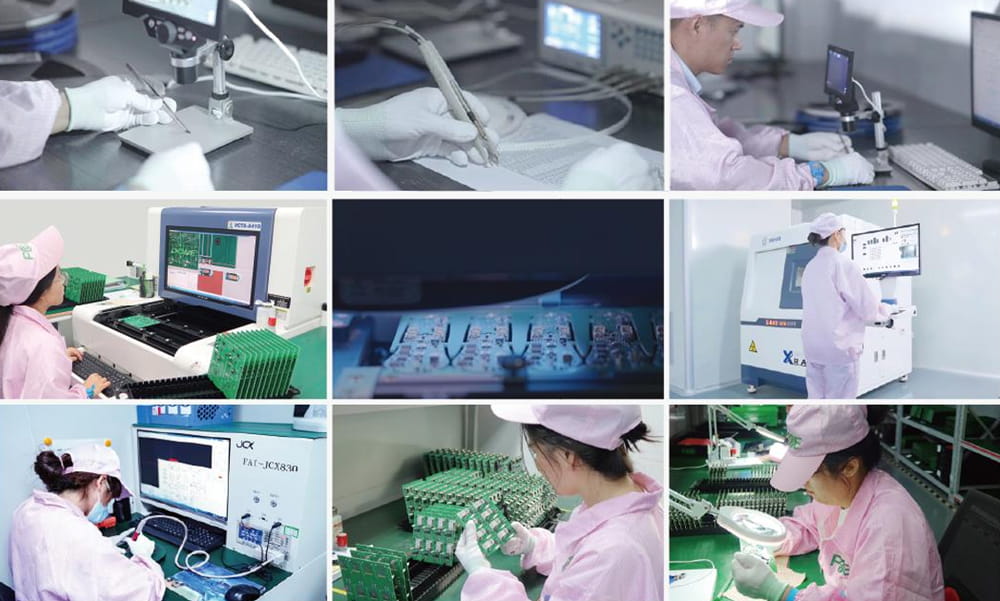
1. No minimum order quantity: From 1 board to 2,000+, governed by the same process controls.2. Fully in-house operation: SMT, ICT, functional test, and box build without external dependencies.
3. Engineer-led DFM/DFT: Every order reviewed prior to assembly.
4. Complete inspection regime: 100% AOI, X-ray for BGAs, and functional testing on every board.
5. Flexible sourcing models: Turnkey, consignment, or labor-only, based on your preference.
6. High-layer expertise: Rigid boards up to 40 layers; advanced flex and rigid-flex capabilities.
7. Recognized certifications: ISO 9001 / 13485 / 14001, IPC-A-610 Class 3, J-STD-001, UL, RoHS, REACH.
8. Predictable scheduling: 5–10 day standard lead times; expedited options evaluated per project.
9. Direct technical access: Sales and engineers available on the same communication thread.
Frequently Asked Questions
Q: What is considered low volume PCB assembly?
A: Generally, 5–2,000 assembled boards. The defining factor is its role in validating design and process before scaling.
Q: How much does low volume PCB assembly cost?
A: Per-board costs are higher than mass production due to fixed setup and lower component pricing leverage. Share your Gerbers and BOM for a transparent quotation.
Q: What files are required?
A: Gerber RS-274X, a complete BOM with manufacturer part numbers, and XY centroid data. We can generate centroid files if necessary.
Q: Can you assemble BGAs and QFNs in low volume?
A: Yes. We place packages down to 0.3 mm pitch and perform 100% X-ray inspection on all BGA assemblies.
Q: Do you support consignment builds?
A: Yes. We accept customer-supplied components and return all unused materials.
Q: How long does low volume assembly take?
A: Standard lead time is 5–10 business days, subject to design complexity and component availability. Expedited scheduling is evaluated on a case-by-case basis.
Q: Is DFM and DFT review included?
A: Yes. Every order includes a free engineering review with actionable recommendations prior to production.
Q: Which industries do you support?
A: Medical, aerospace, defense, industrial automation, IoT, semiconductor test, and related fields. Contact us with your specific application.

 Email: all@poe-pcba.com
 Whatsapp: 85292069596
 Tel: 0755-25312250/ +8613798543496
 Factory Address: Floor 3, Jinyuan Industrial Park, No. 56, Tangtou Avenue, Shiyan Town, Baoan District, Shenzhen China





