PCB Assembly in China
China isn't just a cost-cutting footnote in a supply chain presentation; it is the structural backbone of global electronics manufacturing. Accounting for nearly 60% of global PCB production by value—with the market projected to grow from $78.5 billion in 2025 to $129.7 billion by 2031—the relevant question for most procurement managers and hardware founders is no longer "Should we look at China?" but "How do we navigate it without compromising quality or schedule?"This dominance didn't happen by accident. It is the result of three decades of industrial clustering, aggressive infrastructure investment, and a manufacturing learning curve that no other region has replicated at scale. If you are weighing China against Mexico, Vietnam, or domestic US assembly, you need the unvarnished facts: the real cost math, the hidden risks, and a practical framework to select a partner who won't disappear after receiving your deposit.
Why China Dominates Global PCB Assembly?
The edge isn't just lower wages—that's an outdated narrative. The true competitive moat is vertical integration. In the Pearl River Delta (Shenzhen, Dongguan) and the Yangtze River Delta (Shanghai, Suzhou), you can source laminates, fabricate boards, procure components through dense distribution networks, assemble on SMT lines, and prepare shipments for export—all within a 50 km radius.
Cost Structure: Base assembly costs in China are typically 30–50% lower than in the US. Even after accounting for Section 301 tariffs (25–35%) and freight, net savings for runs above 100–500 units generally remain in the 15–25% range. On bare board fabrication alone, China can be 2.5× to 3× more cost-efficient than US-based production.
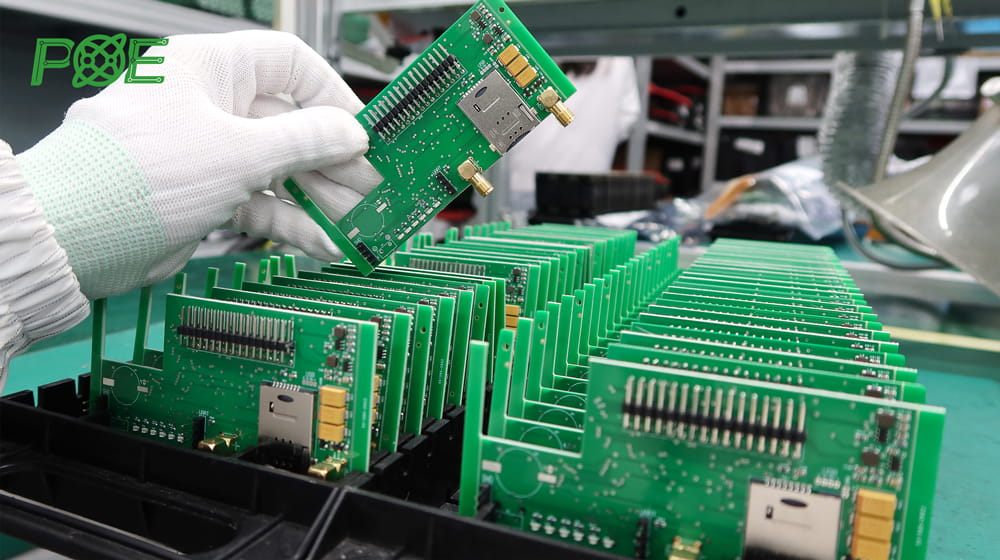
Speed to Scale: Prototypes in days, not weeks. Ramp to 10k+ units without re-quoting the entire supply chain.
Technical Breadth: From standard 4-layer boards to IPC Class 3, HDI, rigid-flex, and fine-pitch placement (01005/BGA/uBGA), the capability spectrum is mature and well-documented.
Shenzhen remains the epicenter for agile, mixed-volume production. The Shanghai–Suzhou corridor leans toward higher-mix, automotive, and medical-grade complexity. Aligning your product profile with the right regional cluster is the first meaningful filter in supplier selection.
The Real Cost Advantage: What the Numbers Say
Strip away the marketing language. A common misconception is that tariffs have eliminated China's cost advantage. They haven't—they've compressed it, but the delta remains significant at volume.
Consider a representative 4-layer IoT control board, 150 components, 500 units (2026 benchmark):
US Assembly: ~$35/board + $300–$800 NRE.
China Assembly: ~$16/board + $50–$150 NQE + freight + 25% tariff.
Landed Reality: Even with duties, the China route typically lands 15–25% lower on a total-cost basis. For bare boards, US fabrication can reach $10.47/unit versus $0.83/unit in China—a ~12× differential at the substrate level, though assembly and logistics narrow that gap for finished PCBA.
Where savings compound is BOM management. We regularly see clients reduce material costs by 15% simply by leveraging a partner's local supply chain instead of importing components at retail pricing from international distributors. In one POE case, a US smart-home OEM cut BOM costs by 15% and improved production efficiency by 20% through lean process optimization and locally sourced, authorized components.
The caveat: the lowest quote is often a red flag. If a factory prices 40% below market, they are likely skipping AOI/X-ray, using gray-market components, or hiding costs in rework. The objective isn't the cheapest board—it's the lowest Total Cost of Ownership (TCO).
Understanding the PCB Assembly Landscape in China
Turnkey: The factory sources PCBs and components. Ideal for most SMEs and startups—you avoid managing hundreds of line items with conflicting MOQs.
Consignment: You supply the parts. Necessary for restricted BOMs (e.g., medical implants with approved vendor lists or regulated applications).
Many buyers assume consignment gives them control—until they become the bottleneck over a missing 0402 resistor.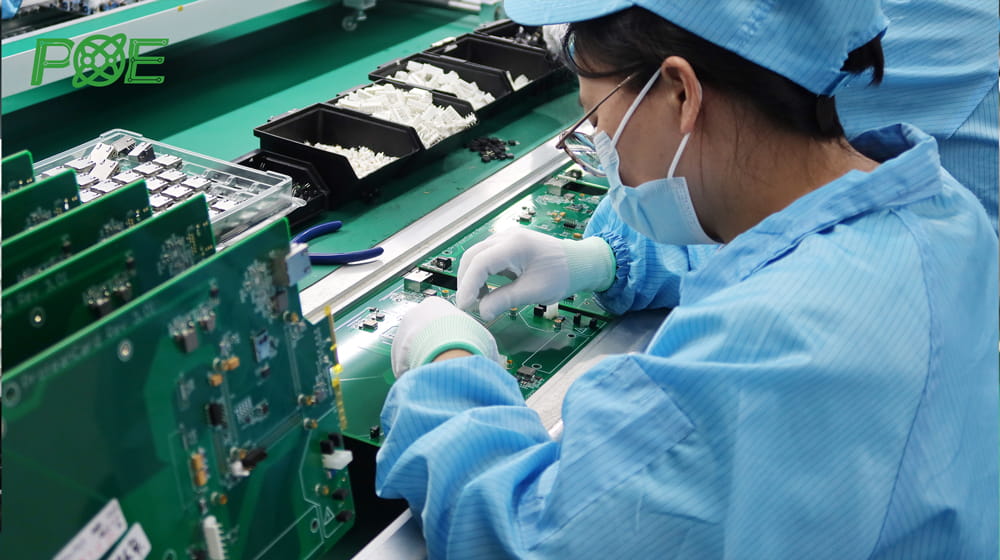
Quality Tiers
Prototype-Focused Online Platforms: Excellent for <10 units, IPC Class 2, automated quoting. Not suitable for ISO 13485 medical runs or high-volume consistency.
Volume-Oriented Production Houses: Dedicated lines, ESD-controlled environments, IPC Class 3 capability.
Specialty Facilities: Rigid-flex, RF (high-frequency laminates), embedded coin technology for thermal management (as seen in advanced research projects).
Component Sourcing and Counterfeit Risks
This is where the "cheap China" narrative collapses without proper safeguards. Counterfeit ICs, relabeled semiconductors, and refurbished passives are real—particularly in high-demand SKUs such as Wi-Fi/BLE SoCs, STM32-class MCUs, NAND flash, and LDOs.
Mitigation is not paranoia; it is process discipline:
Authorized Distribution: For critical actives, source via globally recognized authorized channels. POE maintains traceability to the Certificate of Conformity (CoC) level for all critical components.
Batch Validation: Functional and parametric testing prior to production. Counterfeit parts often survive visual inspection but fail under thermal or electrical stress.
Traceability Systems: Every board and component batch should be logged. When a wearable medical OEM required FDA-aligned traceability, we implemented per-board serial numbers capturing component lot codes and soldering temperature profiles—well beyond what low-cost prototype houses typically offer.
How to Choose a Reliable PCB Assembly Partner in China
1. Certifications and Quality Standards
If a supplier cannot produce current ISO 9001, ISO 13485 (medical), IPC-A-610 Class 3, and J-STD-001 certifications, move on. POE maintains ISO 9001:2015, ISO 13485:2016, ISO 14001, UL, RoHS, and REACH compliance—not as wall decorations, but as audited operational baselines. For medical and automotive buyers, certifications should be binary: yes or no.
2. Manufacturing Capabilities
High-speed SMT (01005, BGA, uBGA)
100% AOI coverage (not sampling)
X-ray inspection for BGAs/QFNs
SPI (Solder Paste Inspection)
Controlled reflow profiling
Any factory that says "we inspect randomly" is optimizing for throughput, not your yield.
3. Engineering Support and DFM
A credible partner critiques your design before invoicing you. POE provides DFM feedback within the same business day—identifying panelization issues, impedance mismatches, or BOM conflicts early. In one wearable sensor program, pre-production DFM resolved rigid-flex stack-up constraints and accelerated time-to-market while reducing rework costs.
4. Component Sourcing Integrity
Does the factory maintain relationships with authorized distributors? Can they provide documentation trails? Do they perform anti-counterfeit inspections? Turnkey only works if the sourcing engine is transparent and documented.
5. Quality Control and Testing
Expect the full sequence: IQC → IPQC → FQC.
IQC: Incoming component verification.
IPQC: In-process checks (solder paste volume, placement accuracy).
FQC: Final AOI/X-ray plus Functional Testing (FCT), ICT, or burn-in as required.
POE enforces 100% inspection, not sampling, with full traceability per board—essential for aerospace data recorders, security systems, and similar applications.
6. Lead Time and Flexibility
Prototypes in 2–5 days? Production in 5–15 days? Can they absorb urgent inserts? A factory running at 85–90% utilization with flexible scheduling (such as POE's ability to scale capacity during demand surges) will outperform a cheaper shop that stalls when you need an extra 500 units.
What to Watch Out For
Pricing 30%+ below market: You'll pay elsewhere—in scrap, delays, or recalls.
"Certification in progress" for months: It likely doesn't exist.
No DFM feedback: They want your order, not your success.
Vague on component origins: "Don't worry, all good quality" is not an answer.
No defect-rate data: If they can't cite yield metrics (e.g., POE's 99.5% acceptance rate), they aren't measuring it.
Slow pre-order communication: If they take three days to reply now, expect worse during a line-down emergency.
Why POE?
Thousands of PCBA facilities operate in Southern China. Most optimize for volume and margin. POE was built for the intersection of quality and agility—the segment where mid-volume OEMs, medical device startups, and advanced hardware innovators operate.
We own our SMT and final assembly lines; we orchestrate tightly integrated PCB fabrication partners. We treat ISO 13485 and IPC Class 3 as operational baselines, not marketing claims. Our engineering team delivers DFM insights within hours, not days. We enforce 100% AOI, X-ray, and functional testing, with per-board serialization and traceability—whether for a five-piece prototype or a 50k-unit medical wearable production run.
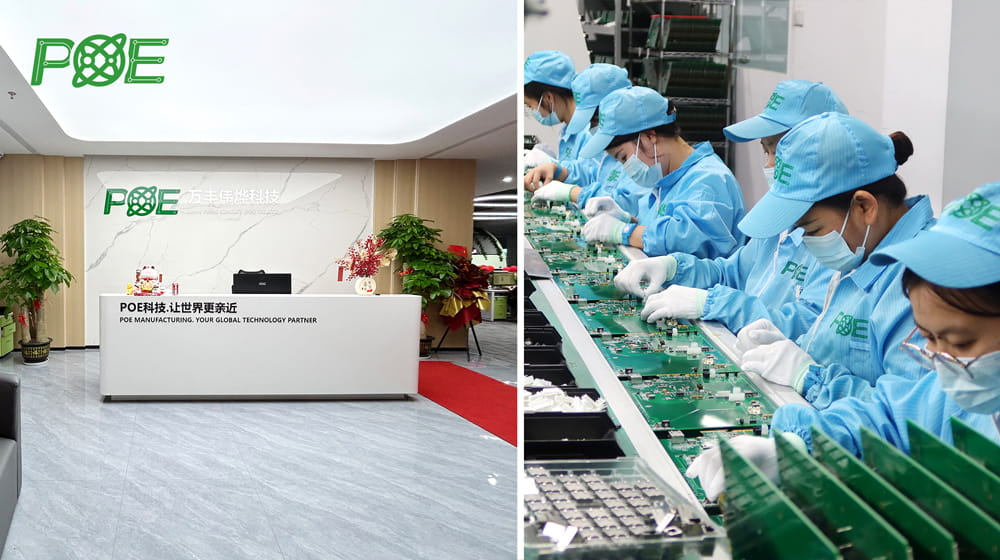
Representative engagements include:
IoT OEMs transitioning volume production from Europe and reducing BOM costs by 15% through optimized local sourcing.
Security system manufacturers requiring fully documented, authorized component sourcing and batch-level traceability.
Advanced robotics developers needing IPC Class 3 workmanship, conformal coating, and burn-in testing for warehouse automation platforms.
University research teams developing non-standard, embedded-copper-coin PCBs for high-power thermal management.
We are not the lowest-cost option. We are the partner who helps ensure your first mass production does not become a recall incident.
FAQ
Q: Why is PCB assembly cheaper in China even with tariffs?
A: Lower labor rates ($4–$8/hr vs $25–$40+/hr), localized material ecosystems (20–40% lower component and logistics costs), and high equipment utilization create a baseline 30–50% cost advantage. After 25–35% tariffs and freight, net savings of 15–25% persist at 100+ units, with bare-board fabrication often 2.5–3× more cost-efficient.
Q: Is quality reliable?
A: It depends entirely on the factory. Many facilities operate at IPC Class 2/3 with proper certifications. The risk lies in the bottom tier—mitigated by auditing certifications, testing protocols, and traceability systems.
Q: Turnkey or Consignment?
A: Turnkey suits roughly 90% of buyers—simpler, faster, and better leveraged for local sourcing. Consignment is appropriate only when you have locked BOMs or strict regulatory requirements.
Q: How long does it take?
A: Prototypes: 2–5 days. Production: 5–15 days (depending on complexity and component availability). Add 3–7 days for international air freight.
Q: What files are required?
A: Gerber files (RS-274-X), a complete BOM with manufacturer part numbers, centroid/XY placement data, and any special assembly drawings. POE performs DFM review on these files prior to any financial commitment.
Q: What are the primary risks?
A: Counterfeit components, IP leakage, communication gaps, and quality inconsistency. All manageable with a transparent, certified partner employing NNN agreements and controlled data access.
Ready to Start Your PCB Assembly Project in China?
Sourcing from China does not require a leap of faith—only disciplined vetting and the right counterpart. If you are currently evaluating suppliers, send us your Gerber files and BOM. We will respond with a DFM analysis and fixed-price quote within 24 hours, transparently itemized so you can compare proposals on equal terms.
No hard sell—just the clarity required to make a supply chain decision you won't regret at 10,000 units.

 Email: all@poe-pcba.com
 Whatsapp: 85292069596
 Tel: 0755-25312250/ +8613798543496
 Factory Address: Floor 3, Jinyuan Industrial Park, No. 56, Tangtou Avenue, Shiyan Town, Baoan District, Shenzhen China





