It is sometimes referred to as hybrid turnkey or combo turnkey. Despite occasional confusion, it is not the same as Consignment. The distinction will become clear below.Full Turnkey vs. Partial Turnkey vs. Consignment
| Dimension |
Full Turnkey |
Partial Turnkey |
Consignment |
| Who provides components? |
Manufacturer (100%) |
Customer supplies some; manufacturer supplies the rest |
Customer (100%) |
| Who procures components? |
Manufacturer |
Shared responsibility |
Customer |
| Who fabricates the PCB? |
Manufacturer |
Manufacturer |
Manufacturer (or customer-provided bare boards) |
| Who assembles? |
Manufacturer |
Manufacturer |
Manufacturer |
| Customer involvement |
Minimal—submit design files |
Moderate—coordinate partial supply |
High—manage entire supply chain |
| Best suited for |
Speed, limited procurement resources |
Existing inventory, special components, preferred suppliers |
Mature supply chains, maximum control |
| Schedule predictability |
High—manufacturer controls sourcing |
Medium—dependent on customer-supplied materials |
Low—dependent on customer’s supply chain |
| Quality ownership |
Manufacturer owns component and assembly quality |
Manufacturer owns assembly; customer owns supplied components |
Customer owns component quality; manufacturer owns workmanship |
Partial Turnkey occupies the middle ground. You retain control over the components that matter most—and transfer the rest to your manufacturing partner.
When Should You Choose Partial Turnkey PCB Assembly?
Choose Partial Turnkey if:
1. You already hold inventory.
Excess stock from prior builds or long-lead-time components already on your shelf can be put to use—without paying a manufacturer to re-purchase the same items.
2. You have proprietary or difficult-to-source components.
Custom ICs, licensed modules, or restricted parts that only you can procure are best kept under your direct control.
3. You have preferred suppliers or stronger pricing.
Where you have established relationships and volume leverage, Partial Turnkey allows you to realize those cost advantages.
4. You want cost efficiency without managing every line item.
You can source critical or high-cost components yourself, while avoiding the overhead of managing every resistor and capacitor.
5. You have specific brand, batch, or qualification requirements.
For regulated or high-reliability applications, Partial Turnkey ensures that critical components meet your exact specifications.
Consider Full Turnkey if:
You lack existing inventory, do not maintain preferred supplier relationships, and prioritize speed and simplicity over granular control.
Consider Consignment if:
You operate a mature supply chain, require absolute control over every component, and have the internal capacity to manage sourcing, logistics, and quality across the entire BOM.
How Partial Turnkey PCB Assembly Works: The Process
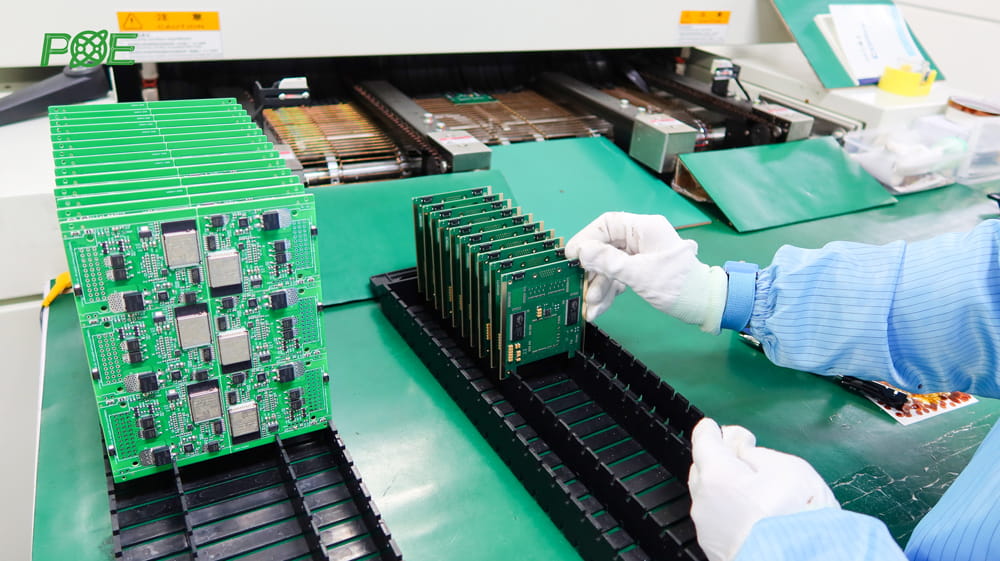
Step 1: BOM Review and Split
You provide your Bill of Materials. Together, we review and segment the BOM into:
Customer-supplied items, clearly identified and documented.
Manufacturer-sourced items, covering the balance of the BOM.
Step 2: Customer Component Procurement and Delivery
You source and prepare the components assigned to you. Best practices include:
Proper labeling and packaging.
An updated, line-item BOM accompanying the shipment.
On-time delivery aligned with the agreed build schedule.
Delays or inaccuracies at this stage directly affect the overall timeline.
Step 3: Manufacturer Component Sourcing
While you manage your portion, POE procures the remaining components through authorized distribution channels, ensuring traceability, compliance, and authenticity.
Step 4: Incoming Inspection and Verification
Upon arrival, your supplied components undergo incoming quality control (IQC):
Quantity verification.
Visual inspection for damage or handling issues.
Cross-check against the approved BOM.
Any discrepancies are escalated immediately. Responsibility for the condition and correctness of customer-supplied components rests with the customer.
Step 5: PCB Fabrication and Assembly
With all components on hand, POE executes:
Bare PCB fabrication.
SMT and/or through-hole assembly.
Automated Optical Inspection (AOI), X-ray (as required), and functional testing.
Conformal coating or other value-added processes, if specified.
Step 6: Final Inspection and Delivery
Finished assemblies undergo final quality assurance and are packaged and shipped according to your requirements.
The Benefits of Partial Turnkey PCB Assembly
1. Component-Level Cost Savings
By sourcing high-value or high-volume components through your own channels, you can reduce total project cost without compromising on quality.
2. Control Over Critical Components
You determine the exact make, source, and batch for the components that carry the highest technical or commercial risk.
3. Efficient Use of Existing Inventory
Partial Turnkey prevents excess inventory from becoming stranded capital, allowing you to consume existing stock effectively.
4. Reduced Workload Compared to Consignment
Unlike full Consignment, you are not responsible for every line item. Standard components—resistors, capacitors, common ICs—can be delegated to your manufacturing partner.
5. Faster Time-to-Build Than Pure Consignment
Because POE sources the majority of components in parallel with your own procurement, Partial Turnkey typically shortens the overall cycle compared to Consignment models.Partial Turnkey vs. ConsignmentThe terms are often conflated. They are structurally different.
| Dimension |
Partial Turnkey |
Consignment |
| Customer-supplied components |
Selected items (critical ICs, long-lead parts, custom components) |
All components |
| Manufacturer-supplied components |
Remaining items (standard passives, common ICs, etc.) |
None |
| Customer procurement effort |
Moderate—selected components only |
High—entire BOM |
| Manufacturer procurement effort |
Moderate—remaining components |
None |
| Schedule risk |
Medium—partially dependent on customer |
High—fully dependent on customer |
| Typical use case |
Existing inventory or special sourcing channels |
Fully developed supply chain, maximum control |
In Consignment, you supply everything. In Partial Turnkey, you supply strategically—and your manufacturing partner assumes the rest.How to Prepare for a Partial Turnkey PCB Assembly Project?Success starts before the first component is ordered.
1. Finalize your BOM.
Ensure part numbers, manufacturers, quantities, and any special equirements are accurate and complete.
2. Identify which components you will supply.
Prioritize:
Items already in inventory.
Components where you have superior pricing or relationships.
Proprietary, custom, or restricted parts.
Long-lead-time items you wish to secure early.
3. Procure and validate early.
Source your assigned components ahead of schedule. Perform incoming inspection on critical items before shipment.
4. Communicate clearly with your manufacturing partner.
Document the BOM split in writing. Confirm responsibilities, timelines, and handling requirements.
5. Plan for contingencies.
Establish backup options for potential delays, shortages, or quality issues.
Why POE for Your Partial Turnkey PCB Assembly?
At POE, we recognize that no two supply chains look the same. Partial Turnkey is not a secondary offering—it is a core competency.
Our capabilities are built to support customers who require both flexibility and rigor:
ISO 13485:2016, ISO 9001:2015, IPC-A-610 Class 3, IPC J-STD-001 certified processes.
Controlled sourcing from authorized distributors—no grey market, no counterfeits.
Rigorous incoming inspection of customer-supplied components.
Full SMT, through-hole, and mixed-technology assembly.
100% inspection protocols, including AOI, X-ray, and functional testing.
Transparent communication and a single point of contact throughout the project.
Scalable support from prototypes through volume production.
We have supported customers across medical, industrial, automotive, and advanced electronics sectors—where reliability is not negotiable, and where Partial Turnkey is often the most effective sourcing strategy.
FAQ
Q: What is partial turnkey PCB assembly?
A: It is a hybrid model in which you supply selected components (typically long-lead, proprietary, or inventoried items), while your manufacturing partner sources the remainder and manages fabrication, assembly, and testing.
Q: How does partial turnkey differ from full turnkey?
A: In full turnkey, the manufacturer sources 100% of components. In partial turnkey, sourcing responsibility is shared.
Q: How does partial turnkey differ from consignment?
A: In consignment, you supply 100% of components. In partial turnkey, you supply a defined subset; the manufacturer supplies the rest.
Q: When is partial turnkey the right choice?
A: When you have existing inventory, proprietary components, preferred suppliers, or specific quality and brand requirements for certain parts.
Q: Which components should I supply in a partial turnkey project?
A: Typically, long-lead-time parts, proprietary ICs, custom components, high-cost items where you have pricing leverage, or components already in stock.
Q: Who is responsible for the quality of customer-supplied components?
A: The customer is responsible for the authenticity, condition, and functionality of supplied components. The manufacturer performs incoming inspection and will escalate issues, but ultimate responsibility remains with the customer.
Q: What happens if my components arrive late?
A: Assembly cannot begin until all components are received. Late delivery of customer-supplied parts will delay the project. Clear scheduling and proactive communication are essential.
Q: How is the BOM split documented?
A: Customer-supplied components are explicitly marked in the BOM. The split is reviewed and confirmed in writing before production commences.
Q: Is partial turnkey more cost-effective than full turnkey?
A: It can be—particularly when you can source critical or high-volume components at better pricing. However, you should factor in your internal procurement costs, logistics, and risk exposure.
Q: Is partial turnkey faster than consignment?
A: Yes. Because the manufacturer sources the majority of components in parallel with your own procurement, partial turnkey generally reduces total cycle time compared to full consignment.
Q: Can partial turnkey be used for prototypes?
A: Yes. It is commonly used for prototypes, particularly when engineering samples of critical components are already available.
Q: What files are required for a partial turnkey project?
A: Gerber files, a complete BOM with customer-supplied items clearly marked, and centroid (XY placement) data.
Ready to Start Your Partial Turnkey PCB Assembly Project?
If you are unsure which components to supply—or whether Partial Turnkey is the right fit—we can help you evaluate.
Share your Gerber files and BOM with POE. We will review your requirements, identify a sensible BOM split, and provide a transparent quotation that clearly defines responsibilities before you commit.
Contact POE by phone, email, or visit our facility.

 Email: all@poe-pcba.com
 Whatsapp: 85292069596
 Tel: 0755-25312250/ +8613798543496
 Factory Address: Floor 3, Jinyuan Industrial Park, No. 56, Tangtou Avenue, Shiyan Town, Baoan District, Shenzhen China





