OEM PCB assembly isn't just a transaction. It's a strategic dependency. Get it right, and your time-to-market shrinks while your margins hold. Get it wrong, and you're explaining to your investors why the prototype works but the production run doesn't.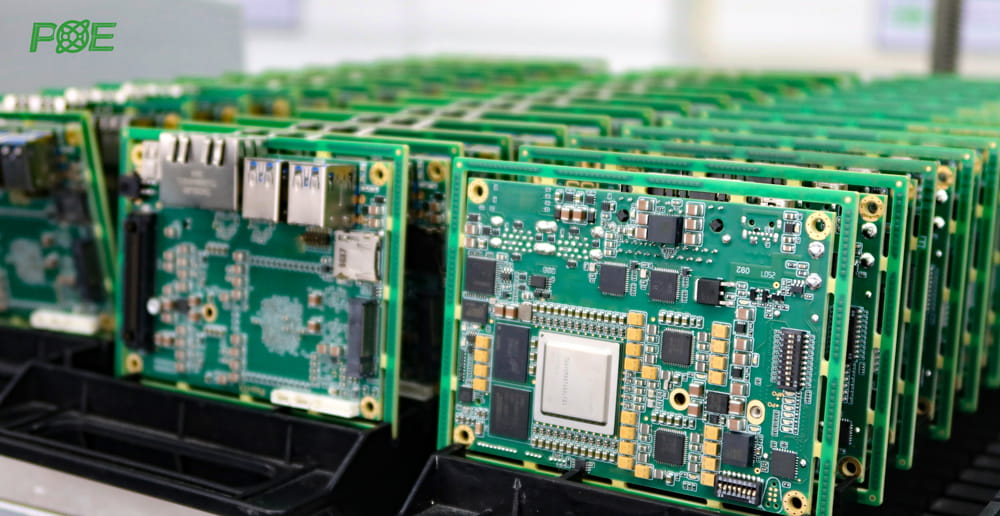
What is OEM PCB Assembly?
OEM stands for Original Equipment Manufacturer. You design the product. You sell it under your brand. You own the intellectual property.
OEM PCB assembly is the practice of outsourcing the fabrication and assembly of your printed circuit boards to a specialized provider. In the hardware world, these providers are typically referred to as EMS (Electronics Manufacturing Services) firms. But here's the nuance: while many EMS companies offer full-box build, POE focuses exclusively on high-reliability PCBA—the heart of your product.
In this model, the lines are clear:
You (the OEM): Define what to build and why it matters. You handle design, firmware, compliance strategy, and the customer relationship.
Your PCBA Partner: Figures out how to build it. They manage PCB fabrication, component sourcing, SMT and through-hole assembly, inspection, and testing.
you focus on innovation; your partner ensures that innovation survives contact with the manufacturing floor.
OEM vs. EMS
| Dimension |
OEM (You) |
EMS/PCBA Partner |
| Core Role |
Design, Brand, Market |
Precision Manufacturing |
| Design Control |
Full ownership |
DFM/DFT feedback only |
| IP Ownership |
Retained by OEM |
Protected under NDA |
| Manufacturing |
Outsourced |
Core competency |
| Supply Chain |
Strategy & Spec |
Execution & Logistics |
| Scale |
Demand driven |
Capacity ready |
This isn't a vendor relationship. It's a dependency. Apple doesn't compete with Foxconn; they leverage them. Your job is to ensure your manufacturing partner is an extension of your engineering team, not a black box overseas.
Why Outsource PCB Assembly?
Everyone says outsourcing saves money. That's a byproduct, not the strategy. The real value lies in risk mitigation and operational leverage.
1. Focus on Core Competencies
Your competitive advantage isn't in running SMT lines; it's in your firmware architecture, your industrial design, and your understanding of the end-user. Outsourcing frees up your engineers from fighting solder paste issues so they can focus on the next product iteration.
2. Instant Access to Capital-Intensive Infrastructure
A modern SMT line with AOI, X-ray, and nitrogen reflow ovens costs millions. Hiring and retaining process engineers takes years. When you outsource, you aren't buying equipment; you're renting a turnkey system that's already optimized.
3. Supply Chain Resilience
This is where most OEMs underestimate the risk. Managing a BOM of 300+ components means tracking 300+ potential points of failure—obsolescence, allocation, and counterfeiting. A professional PCBA partner aggregates demand across dozens of clients. We maintain relationships with authorized distributors (Arrow, Avnet, Future Electronics) that you likely don't have. When a chip goes EOL, we see it coming months in advance.
4. Speed to Market
In-house assembly sounds controllable until you hit a bottleneck. An experienced partner has pre-qualified alternate components and established logistics. We've seen OEMs cut 3 weeks off their launch schedule simply by moving from a fragmented supplier model to a single-source PCBA partner.
5. Quality as a System
Compliance isn't a checkbox; it's a process. Working with a partner holding ISO 13485 (Medical), ISO 9001, and IPC-A-610 Class 3 certifications means quality is baked into the workflow, not inspected in at the end.
The Process: From Gerber to Finished Board
Design Handoff: You provide Gerbers, BOM, centroid files, and specs.
DFM Review: Before a single board is milled, we analyze your design for manufacturability. This is where we earn our keep—identifying silkscreen clashes, insufficient annular rings, or thermal reliefs that could cause tombstoning.
Procurement: Components are sourced strictly from authorized channels. No grey market. No "functional equivalents" without your written approval.
Assembly: SMT placement, reflow, through-hole insertion, and wave soldering.
Testing: 100% AOI and X-ray (for BGAs/QFNs). ICT and functional testing verify the board behaves as intended.
Value-Add: Conformal coating, potting, or final packaging.
Choosing Your Model: Turnkey vs. Consignment
Full Turnkey: The partner handles everything. Best for startups or when you want to minimize administrative overhead.
Partial Turnkey: You supply the long-lead or proprietary items (e.g., custom ICs); the partner sources the rest. A good balance of control and convenience.
Consignment: You supply all parts. Best for mature OEMs with deep purchasing power and strict audit requirements.
Many OEMs start with consignment thinking it saves money. Often, they end up paying more in air freight and receiving delays because they underestimated the complexity of managing inbound logistics to a factory floor.
How to Choose an OEM PCB Assembly Partner?
1. Audit Their Engineering Discipline
Ask to see a sample DFM report. If it's a generic PDF with a green checkmark, walk away. A real report contains specific coordinates, suggested trace width adjustments, and panelization strategies.
2. Verify Certifications Against Your Industry
If you're in MedTech, ISO 13485 isn't optional. For industrial IoT, IPC Class 3 is the standard for durability. Ask for certificates—and then ask how they enforce those standards daily.
3. Probe Their Sourcing Strategy
This is the most critical question: “How do you handle component shortages?” A competent partner will explain their buffer stock policies, their authorized distribution network, and their process for proposing "Form-Fit-Function" alternates. If they say "we'll cross that bridge when we come to it," they are a liability.
4. Test Their Communication
Send them a complex technical question at 10 AM EST. Do you get a response from a salesperson or an engineer? In the hardware world, response time is directly correlated with production downtime.
5. Look for Transparency in Inspection
Anyone can say they do "100% inspection." Ask how they track false calls. Ask about their first-pass yield rates. Data doesn't lie; salespeople do.
Why POE for Your OEM PCB Assembly?
At POE, we are not a generalist EMS provider. We are specialists in high-reliability PCB assembly. Based in China, we serve OEMs globally, bridging the gap between Western engineering standards and Asian manufacturing efficiency.
Certifications that matter: ISO 9001:2015, ISO 13485:2016, IPC-A-610 Class 3, J-STD-001, and UL certification ensure your boards meet the most stringent requirements for medical, industrial, and communications equipment.
Zero-tolerance sourcing: We buy only from authorized distributors. Period.
Engineering-led service: Every order includes a rigorous DFM review. We'd rather tell you your design needs a tweak than let it fail in the field.
Flexibility: Whether you need 10 prototypes or 10,000 production units, our lines are configured for both agility and scale.We've spent years helping OEMs in Industrial IoT and Communications navigate component crises and accelerate their path to market. We don't just assemble boards; we protect your brand reputation on the production line.
FAQ
Q: What files do I need to provide?
A: Gerber files (RS-274X), a complete BOM (with manufacturer part numbers), Centroid (XY) data, and any specific assembly instructions or programming files.
Q: What is the difference between OEM and EMS?
A: OEMs design and market the product. EMS providers manufacture it. Think of it as the architect (OEM) versus the general contractor (EMS).
Q: How do you handle component obsolescence?
A: We monitor BOMs against lifecycle databases. When an EOL notice appears, we immediately alert you with cross-reference suggestions that meet your technical and compliance requirements.
Q: What is IPC Class 3, and do I need it?
A: IPC Class 3 is the highest standard for PCB assemblies, requiring higher precision and stricter process controls. It's essential for mission-critical applications in medical, aerospace, and high-end industrial markets.
Ready to Build?
You've done the hard work designing the product. Don't let the manufacturing phase undermine it. Send us your Gerber files and BOM. We'll respond within 24 hours with a DFM analysis and a transparent quote—no corporate speak, just engineering clarity.
Contact POE. Let's build something reliable.

 Email: all@poe-pcba.com
 Whatsapp: 85292069596
 Tel: 0755-25312250/ +8613798543496
 Factory Address: Floor 3, Jinyuan Industrial Park, No. 56, Tangtou Avenue, Shiyan Town, Baoan District, Shenzhen China





