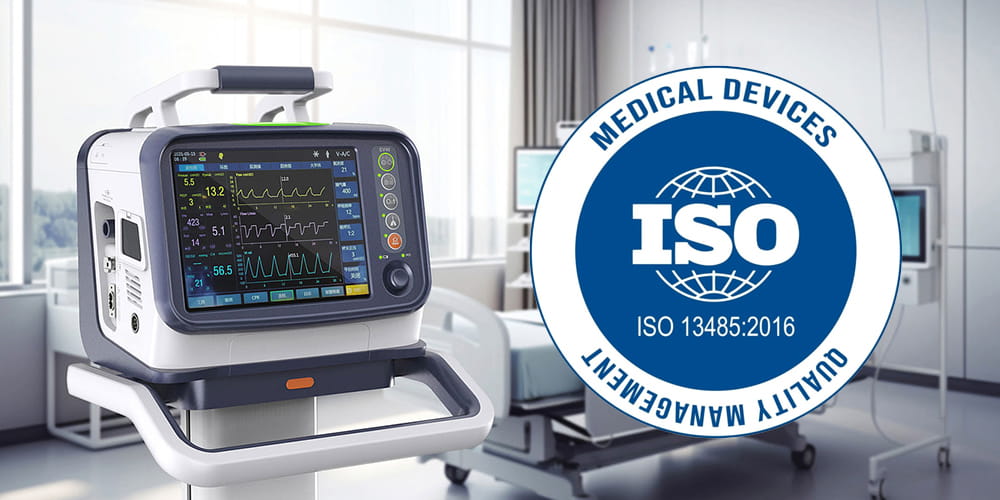
Many factories hold an ISO 9001 certificate and assume it's enough. It isn't. While ISO 9001 provides a solid foundation for general quality management, ISO 13485 adds the rigorous layers required for medical safety.
| Dimension |
ISO 9001 (General Manufacturing) |
ISO 13485 (Medical Devices) |
| Primary Focus |
Customer satisfaction & continuous improvement. |
Patient safety & regulatory compliance. |
| Documentation |
Standard operating procedures. |
Extensive, controlled documentation; every record must be auditable. |
| Traceability |
Basic batch tracking. |
Unit-level or lot-level traceability from raw material to finished goods. |
| Process Validation |
Recommended for key processes. |
Mandatory for Special Processes (e.g., soldering, coating). |
| Risk Management |
General risk assessment. |
Comprehensive risk management integrated throughout the QMS. |
| Change Control |
Internal process changes. |
Strict control; any change affecting the device requires formal review and customer notification. |
ISO 9001 says a factory has a system. ISO 13485 proves that system is designed specifically to prevent harm in a clinical setting.
What ISO 13485 Requires from a PCB Assembly Partner?
When you walk into a potential supplier's facility, here is what a true ISO 13485-compliant operation looks like on the ground:
1. Documented Quality Management System (QMS)
It's not enough to have a binder of procedures. The QMS must be a living system. At POE, our QMS dictates that every process—from solder paste printing to final packing—is standardized. Every deviation triggers a Non-Conformance Report (NCR), and every Corrective and Preventive Action (CAPA) is tracked to closure.
2. Full Component and Process Traceability
This is where many assemblers fail. ISO 13485 requires that every component be traceable.
We maintain a digital thread linking every Serial Number to the specific Lot and Date Codes of the components used, the solder paste batch, the reflow oven profile, and the operator ID.
If a component recall occurs, you can identify exactly which units are affected in minutes, not weeks.
3. Process Validation
You cannot "inspect quality into a product" if the process itself is invisible. Soldering, conformal coating, and cleaning are "special processes."
We validate our reflow profiles using thermal profiling systems and perform regular verification. Our Class 3000 cleanroom and ESD-protected environments aren't just clean; they are validated to ensure contaminants don't compromise device reliability.
4. Supplier Management and Change Control
Gray market components are the bane of medical procurement. We source exclusively from authorized distributors. More importantly, our change control process mandates that any proposed Bill of Materials (BOM) change is formally reviewed, tested, and documented in the project's technical file—with your approval—before implementation.
5. Rigorous Inspection Regimen
For medical devices, sampling is not enough.
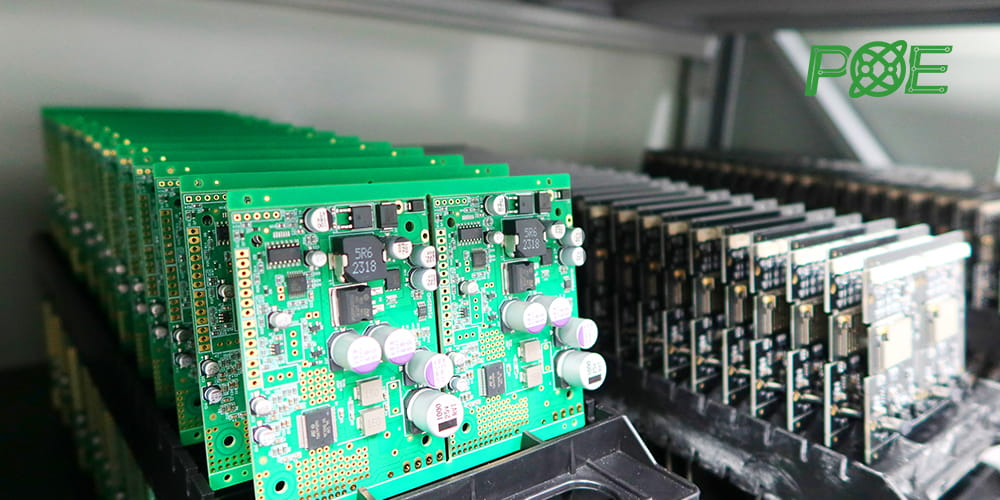
Every board undergoes 100% AOI to catch solder bridging and component presence. BGAs and bottom-terminated components receive 100% X-ray inspection to verify hidden joints. This is backed by comprehensive In-Circuit Testing (ICT) and Functional Testing (FCT) to ensure the board performs exactly as designed.
Industries and Applications Requiring ISO 13485 PCB Assembly
The stakes vary, but the standard remains high across the board:
Implantable Devices: Pacemakers and neurostimulators requiring Class 3 workmanship and absolute traceability.
Surgical Robotics: High-density interconnects where precision and cleanliness are paramount.
Patient Monitoring: ECG and SpO2 monitors where data integrity saves lives.
Diagnostic Imaging: CT and MRI systems requiring complex, multi-layer boards.
Drug Delivery: Infusion pumps where zero-defect reliability is non-negotiable.
Why POE for Your ISO 13485 PCB Assembly Needs?
At POE, we don't treat ISO 13485 as a hurdle to clear; we treat it as the baseline for patient safety. We specialize in the small-to-medium batch complexity that defines modern medical innovation—from iterative prototypes to full production runs.
Our Class 3000 cleanroom, rigorous 2D AOI and X-ray inspection, and unwavering commitment to authorized component sourcing ensure that your PCB assemblies meet the stringent demands of the medical industry. We provide complete Device History Records (DHR) with every shipment because we know your regulatory submission depends on it.
Most importantly, our engineering team provides proactive DFM analysis to ensure your design is not just manufacturable, but reliable. We build boards that save lives; we don't just fill purchase orders.
FAQ
Q: Is ISO 9001 enough for medical device PCB assembly?
A: No. ISO 9001 covers general quality principles. ISO 13485 adds the specific requirements for risk management, traceability, and regulatory compliance mandatory for medical devices.
Q: Does ISO 13485 apply to prototypes?
A: Yes. Even prototype boards intended for clinical trials or verification must be built under controlled conditions to ensure data integrity and patient safety.
Q: What does "Class 3000" mean for PCB assembly?
A: A Class 3000 cleanroom maintains a maximum particle count of 3,000 particles (0.5 microns or larger) per cubic meter of air.
This controlled environment prevents particulate contamination that could cause failures in sensitive medical electronics.
Ready to Start Your ISO 13485 PCB Assembly Project?
Medical devices demand more than just a working circuit; they demand a manufacturing partner you can trust.
Send us your design files. We'll provide a detailed DFM review focused on medical reliability and a transparent, fixed-price quote within 24 hours. Let's build something that makes a difference.

 Email: all@poe-pcba.com
 Whatsapp: 85292069596
 Tel: 0755-25312250/ +8613798543496
 Factory Address: Floor 3, Jinyuan Industrial Park, No. 56, Tangtou Avenue, Shiyan Town, Baoan District, Shenzhen China





