Web Analytics Made Easy - Statcounter
Full Turnkey PCB Assembly: One Workflow, One Partner
This website uses cookies:
Our website use cookies to analyze website accesses and improve your online experience. By continuing browsing this website,you agree to our use of cookies and privacy policy.
Accept all cookies
Decline
This website uses cookies:
Our website use cookies to analyze website accesses and improve your online experience. By continuing browsing this website,you agree to our use of cookies and privacy policy.
Accept all cookies
Decline
Get A Quote
Get A Quote
Full Turnkey PCB Assembly: One Workflow, One Partner
14 July 2026
Views: 74

Full Turnkey PCB Assembly


You're staring at three open email threads: the PCB fabricator missed the lamination deadline, the component distributor just backordered your QFN chips, and the assembly house is blaming “board warpage” for the failed solder joints. You're not building hardware—you're playing supply chain referee. Every hour you spend chasing vendors is an hour stolen from debugging firmware, refining your BOM, or getting to market before your competitor. This isn't how engineering teams scale. It's how they stall.


The Hidden Cost of Managing Multiple PCB Vendors


Splitting PCB fabrication, component sourcing, and assembly across three suppliers feels like control—until it becomes chaos. Communication lags stack up: the assembler waits five days for boards from the fabricator, who blames late solder mask files. When a batch fails ICT, the fabricator points to “poor component quality,” while the distributor cites “improper reflow profiles.” You're left mediating blame while your prototype timeline slips by weeks. What this means for you:​ You're not paying for three services—you're paying for three layers of inefficiency, three sets of shipping fees, and dozens of hours of unplanned project management. Your real product isn't a managed vendor list; it's a functional, tested PCBA.

Full Turnkey PCB Assembly

What Full Turnkey PCB Assembly Actually Means

Full turnkey PCB assembly is a single-source workflow: you submit your Gerber files, BOM, and centroid data. Your partner handles everything else—from qualifying components and fabricating bare boards to SMT/THT assembly, AOI/X-ray inspection, and functional testing. No middlemen. No handoffs. No “who's responsible?” debates. In short:​ You provide the design intent. We deliver production-ready assemblies, shipped to your dock on schedule.

4 Ways Full Turnkey Assembly


1. Lower Total Cost of Ownership (TCO)


It's not just about negotiating better component prices (though we do that too). The real savings come from eliminating hidden costs: $200+ in redundant freight fees per build, 20–30 hours of engineering time spent chasing POs, and the opportunity cost of delayed launches. For you:​ A 10% reduction in unit cost is meaningless if you're burning $15k/month in project management overhead. Full turnkey cuts both direct and indirect expenses.

2. Faster Time-to-Market

Every handoff between vendors adds 3–5 days of idle time. In full turnkey, fabrication, component kitting, and assembly run on a synchronized schedule. We've cut prototype lead times by 7–10 days for clients moving from split sourcing to turnkey—time that translated directly into early retail shelf placement. For you:​ Speed isn't a luxury; it's market share. A week saved in prototyping can mean beating a competitor to a trade show demo or securing a key OEM contract.

3. Single Point of Accountability

When a board fails, there's no finger-pointing. We own the entire process—from bare board quality to solder joint integrity. If our AOI catches a misaligned component, we fix it. If X-ray reveals a voided BGA, we rework it. For you:​ One phone call resolves issues. No more “it's not our problem” emails. Just accountability for the final product.

4. Built-In DFM/DFT Expertise

Most failures start with design choices that look good on a schematic but fail in production—like 0.4mm pitch BGAs without solder mask expansion or test points buried under components. Our engineers run DFM (Design for Manufacturability) and DFT (Design for Testability) reviews beforefabrication. Last quarter, we caught 14 BOM errors and 9 layout issues for clients—preventing $12k+ in scrap costs. For you:​ Problems get solved in the design phase, not after you've already paid for 500 boards.

Full Turnkey vs. Partial Turnkey: Which One Is Right for You?


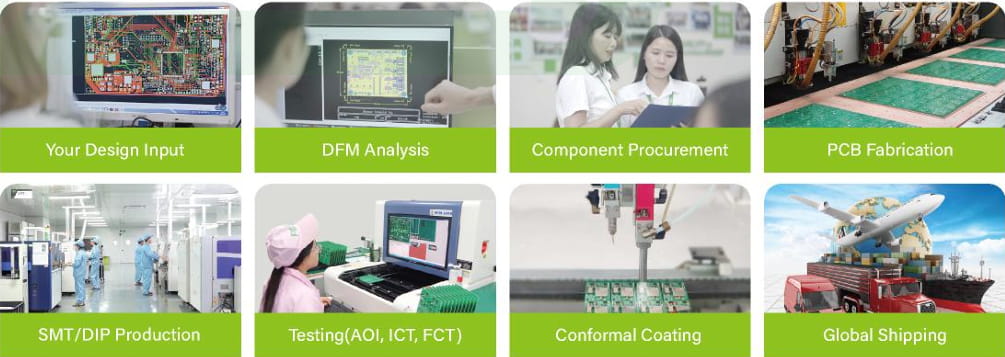
Full Turnkey process

Full Turnkey:​ We source allcomponents, fabricate boards, and assemble. Ideal for teams with limited procurement bandwidth, small-to-medium BOMs, or those avoiding the hassle of managing distributors.

Partial Turnkey:​ You supply critical/specialty components (e.g., custom ICs, legacy parts); we handle the rest. Best for teams with existing supplier relationships for hard-to-find parts.

Our take:​ If your team spends more than 5 hours/week on component sourcing, full turnkey will pay for itself in reclaimed engineering time alone.

What to Look for in a Full Turnkey PCB Partner


Not all turnkey providers are equal. Vet partners against these four criteria:

Supply Chain Stability:​ Do they have direct relationships with franchised distributors (Arrow, Avnet) and a track record of mitigating allocation risks?

Rigorous QC:​ Beyond basic AOI, do they offer X-ray for BGAs, ICT for complex boards, and functional testing aligned with IPC-A-610 Class 2/3 standards?

Proactive Engineering Support:​ Will they flag DFM issues beforeproduction? Ask for a sample DFM report—if it's generic, walk away.

Transparent Delivery History:​ Can they share on-time delivery rates (we maintain 98.2% for turnkey projects)? Vague promises beat no numbers every time.

Ready to Stop Managing Vendors and Start Building Products?


You didn't become an engineer to chase POs or mediate vendor disputes. Let's simplify your workflow. Upload your Gerber files and BOM today—our engineering team will complete a comprehensive DFM review and send you a detailed quote within 24 hours.​ No obligation. Just clarity on how to get from design to functional PCBAs faster, cheaper, and with zero supply chain headaches.

FAQ: 


What is full turnkey PCB assembly?​


Full turnkey PCB assembly is a single-source manufacturing model where one provider manages the entire production workflow: PCB fabrication, component sourcing, SMT/THT assembly, inspection (AOI/X-ray), and functional testing. The customer provides only design files (Gerber, BOM, centroid data) and receives finished, tested PCBAs.

What's the difference between full turnkey and partial turnkey PCB assembly?​


In full turnkey, the manufacturer sources allcomponents and manages the entire process. In partial turnkey, the customer supplies specific components (e.g., proprietary ICs, hard-to-find parts) while the manufacturer handles the rest. Full turnkey minimizes customer workload; partial turnkey offers more control over critical component sourcing.

What files do I need to provide for a full turnkey PCB assembly project?​


You'll need: (1) Gerber files (RS-274-X or Gerber X2 format) for PCB fabrication; (2) A complete BOM (Excel/CSV) with manufacturer part numbers, quantities, and reference designators; (3) Centroid data (pick-and-place file) specifying component coordinates and rotations; (4) Schematic files (optional, but helpful for DFT reviews).

How does full turnkey PCB assembly reduce costs?​


It eliminates redundant shipping fees, reduces engineering time spent on vendor coordination, leverages bulk component purchasing power, and prevents costly rework via pre-production DFM/DFT reviews. Most clients see 15–25% lower total cost of ownership compared to split sourcing.

How long does a full turnkey PCB assembly project typically take?​

Prototype builds (10–50 units) average 7–12 business days from file approval to delivery. Production runs (500+ units) range from 2–4 weeks, depending on component lead times. Critical-path delays are minimized because there are no inter-vendor handoffs.

Share This Story, Choose Your Platform!
Application of related products
Whatsapp: 85292069596
Files (zip or rar files accepted. Max 20MB.)
Link Us on