Optical/sensor dies: A 20 µm speck on a lens or MEMS membrane is the defect.Cleanroom Classifications for PCB Assembly
| ISO Class |
FED-STD-209E |
≥0.5 µm/m³ |
Where it actually lives |
| ISO 5 |
Class 100 |
3,520 |
Photolithography, wafer-level packaging |
| ISO 6 |
Class 1000 |
35,200 |
Fine-pitch SMT, BGA/CSP, flex, wire bonding |
| ISO 7 |
Class 10,000 |
352,000 |
Standard SMT, backend |
| ISO 8 |
Class 100,000 |
3,520,000 |
Etching, plating, wave |
Most people quoting "cleanroom PCB" are actually talking ISO 7 or 8. Class 1000 (ISO 6) sits in the middle—clean enough to protect fine-pitch and high-reliability builds, sane enough to run volume.
If your board is headed for a car, a plane, or a patient, ISO 7 is a gamble.
Class 1000 Cleanroom PCB Assembly: Technical Requirements
1. Air Filtration and Particle Control
HEPA filters: ≥99.97% efficiency at 0.3 µm
High air change rates: enough to dilute what people and machines shed
Positive pressure cascade: 10–15 Pa between zones so dirt flows away from the product
Laminar (unidirectional) flow over critical process areas
2. Temperature and Humidity
20–25°C, ±0.5°C for precision work
45–65% RH
Stable enough that solder paste doesn't age while sitting on the stencil
3. ESD Control
Grounding: 0.1–1 MΩ
ESD flooring: 10⁶–10⁹ Ω
Wrist/heel straps on every operator
Air ionizers at placement and bonding stations
40–70% RH, continuously held
ESD doesn't announce itself. It just kills a die and lets you chase it for two weeks.
4. Personnel and Material Flow
People make 75–80% of the contamination.
Air showers before entry—mandatory, not optional
Full gowning: coverall, hood, gloves, booties. No skin showing.
Pass-through boxes for boards, reels, stencils
Conveyor air tunnels on exits
A fully gowned operator standing still emits ~100,000 particles ≥0.3 µm per minute. Walking? Multiply by ten. This is why discipline matters more than square footage.
5. Monitoring and Certification
A cleanroom is not clean because it's white and smells like filters.
Particle counts: static + dynamic, ≥0.5 µm minimum
Airflow velocity checks
Pressure differential verification
Continuous temp/RH logging
Full ISO 14644-1 recertification every 6–12 months
When Does PCB Assembly Require Class 1000 (ISO 6)?
| Application |
Why ISO 6 |
| ≤0.4 mm pitch components |
Tolerance for particles collapses |
| BGA/CSP |
200 µm gap between balls—one fiber = open |
| Flex circuits |
More sensitive to handling and contamination |
| Wire bonding / die attach |
25 µm features don't forgive |
| Medical electronics |
Zero-defect isn't a slogan |
| Aerospace & defense |
NASA-grade assemblies default to Class 1000 |
| Optical & MEMS sensors |
20 µm = functional failure |
| Automotive ADAS / safety |
Field failure is not an option |
If your pitch is below 0.4 mm, your trace is near 50 µm, or your end customer writes "high reliability" into the PO—Class 1000 is not a choice. It's the only option.Class 1000 vs. Class 100 vs. Class 10,000
| Class |
ISO |
Particles ≥0.5 µm/m³ |
Use it for |
| 100 |
ISO 5 |
3,520 |
Semiconductor, photolithography |
| 1000 |
ISO 6 |
35,200 |
Fine-pitch PCB, BGA, flex, bonding |
| 10,000 |
ISO 7 |
352,000 |
Standard SMT |
| 100,000 |
ISO 8 |
3,520,000 |
General assembly |
If only BGA placement and fine-pitch printing need the extra cleanliness, put an ISO 5 mini-zone inside an ISO 7 room. Cheaper than upgrading the whole floor.
Industry Standards That Actually Matter
ISO 14644-1:2015 – cleanroom classification
IPC-A-610 Class 2 / 3 – workmanship and cleanliness
IPC J-STD-001 – soldering requirements
IPC-5704 – bare board cleanliness
NASA-STD-8739.x – space-grade (Class 1000 baseline)
AS9100 / IATF 16949 / ISO 13485 – industry QMS
RoHS / REACH / UL – compliance baseline
How to Choose a Class 1000 Cleanroom PCB Assembly Partner?
1. Ask for the ISO 14644-1 certificate
It must say:
ISO Class 6 (Class 1000)
Occupancy state (at-rest or operational)
Date and expiry
Accredited lab name
2. Ask about particle monitoring
How often? (monthly is baseline)
Which sizes?
Static + dynamic?
What happens when it drifts?
3. Walk the gowning protocol
If they let you in with a beard showing and no air shower, they don't understand the word controlled.
4. Check ESD
Grounding scheme
Ionizers
RH band
Training records
5. Match their certs to your market
We hold:
ISO 9001:2015 · ISO 13485:2016 · ISO 14001:2015
IPC-A-610 Class 3 · IPC J-STD-001
RoHS · REACH · UL
6. Ask for the boring stuff
Cleanliness reports per lot?
Defect rates on cleanroom builds?
References from your industry?
Why POE for Your Class 1000 Cleanroom PCB Assembly?
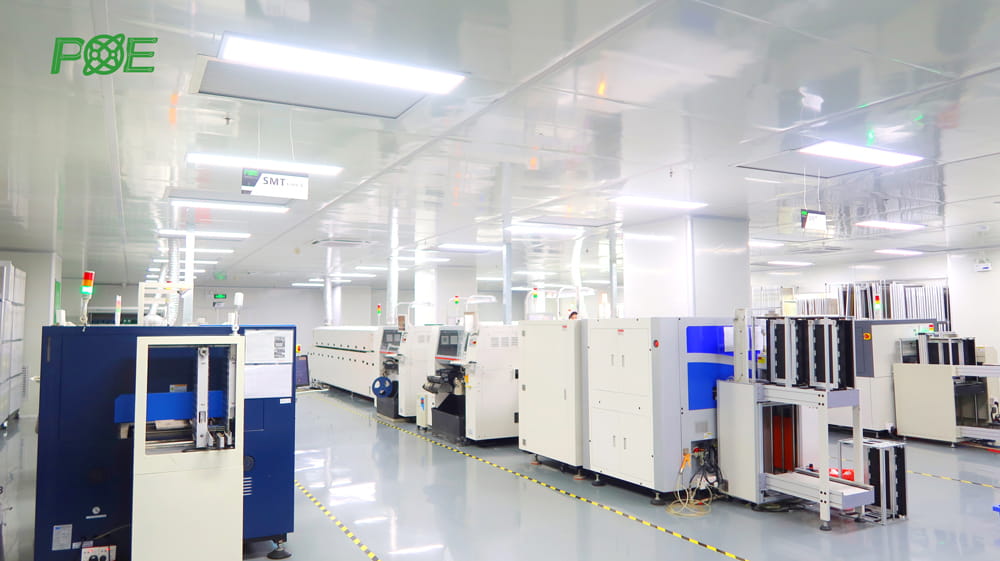
At POE, ISO 6 is a working environment—recertified, monitored, and enforced.
HEPA-laminar flow. 45–65% RH. Full gowning. Air showers. Pass-throughs. ESD from floor to ionizer. And yes, particle counts you can actually read.
We run fine-pitch SMT, BGA/CSP, flex, and wire bonding inside that envelope every day—for customers building automotive ADAS, aerospace systems, medical electronics, and high-end sensors.
Every shipment includes:
Cleanliness documentation
Particle count records (on request)
Full IPC-A-610 Class 3 inspection
You're not buying a cleaner room.
You're buying the fact that your board won't fail in the field.
Class 1000 isn't more clean.
It's the only way the job survives.
FAQ
1. What is a Class 1000 cleanroom in PCB assembly?
A controlled space limited to 1,000 particles ≥0.5 µm per ft³—ISO Class 6 under ISO 14644-1.
2. Is Class 1000 the same as ISO 6?
Yes. Different naming systems, same air.
3. Class 1000 vs Class 10,000?
Class 1000 is ten times cleaner. For fine-pitch and high-reliability, that factor is the difference between pass and recall.
4. When do I actually need it?
≤0.4 mm pitch, BGA/CSP, flex, wire bonding, medical, aerospace, ADAS, sensors. If you hesitated on that list, you already know.
5. How much does it cost?
Enough to matter, not enough to compare to a single recall. Most operations see 12–18% yield recovery after moving to ISO 6. That's the real price tag.
6. Can I run prototypes in Class 1000?
Yes. 1 board or 1,000—if the application demands it, the room doesn't care.
7. How do I know a supplier is real?
Ask for the ISO 14644-1 cert. If they send a photo of a clean-looking room instead, you have your answer.
Ready to Build Without the Gamble?
Send us your files.
We'll review what your design is actually asking for—and tell you, straight, whether Class 1000 is required or just recommended.

 Email: all@poe-pcba.com
 Whatsapp: 85292069596
 Tel: 0755-25312250/ +8613798543496
 Factory Address: Floor 3, Jinyuan Industrial Park, No. 56, Tangtou Avenue, Shiyan Town, Baoan District, Shenzhen China





