There is a myth that one-stop is only for low-volume prototypes. This is false. While it excels at NPI (New Product Introduction) by reducing iteration time, a robust one-stop partner provides stability for mass production. By managing the supply chain at scale, they can often secure better component pricing than a small purchasing department.
When Should You Choose One-Stop PCB Assembly?
Choose One-Stop if:
You hate being a mediator. You want one person to blame (or praise) for the entire project.
You are in the NPI phase. You need to iterate fast without setting up new vendors for every revision.
You run high-mix, low-volume production. Managing 10 different vendors for 10 different SKUs is a nightmare; one-stop makes it manageable.
You lack a dedicated supply chain team. Most startups and SMEs fall into this category.
Your design is complex. If you are working with BGAs, fine-pitch components, or rigid-flex boards, you need tight integration between fabrication and assembly.
Stick with Multi-Vendor if:
You have a massive, highly-optimized supply chain team.
You have massive volumes where shaving $0.01 per board justifies weeks of coordination.
You have massive legacy inventory of components you must use.
How to Choose a One-Stop PCB Assembly Partner (Without Getting Burned)
Not all "one-stop" shops are created equal. Many are simply brokers who outsource everything. Here is how to vet them:
Ask about their factory vs. their partners. It's okay to have partners for PCB fabrication, but the assembly must be in-house. Ask: "Which processes do you own, and which do you manage?" Transparency here is key.
Verify their certifications. Don't just take their word for it. Ask for copies. For medical or automotive, ISO 13485 and IATF 16949 (or equivalent rigor) are non-negotiable.
Check their inspection standards. Do they do 100% AOI? Do they X-Ray BGAs? If they say "sample inspection," run.
Test their engineering support. Send them a challenging design and ask for a DFM report. A serious partner will spend time reviewing your files for free before you pay a dime. If they just give you a price without questions, they aren't paying attention.
Why POE for Your One-Stop PCB Assembly Needs
At POE, we built our one-stop model around a simple principle: Supply chain is our problem, not yours.
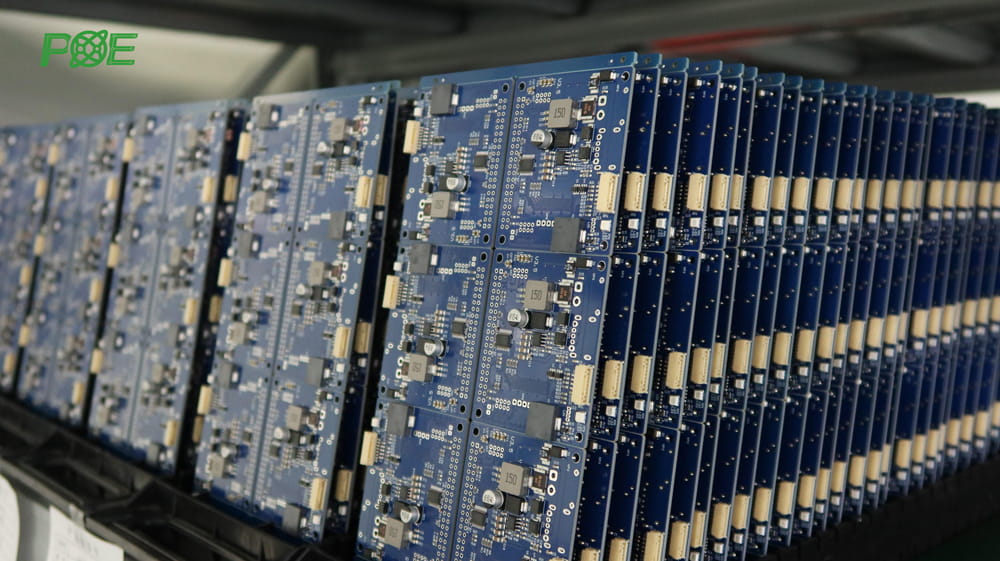
We operate our own SMT assembly facility, ensuring that the most critical stage—the physical placement of components—is done under our direct supervision. For PCB fabrication and other specialized processes, we act as the integrator, holding our partners to our strict standards, including IPC-A-610 Class 3 workmanship.
Our approach is defined by:
Certified Quality: We are certified to ISO 9001:2015, ISO 13485:2016, ISO 14001:2015, and comply with IPC J-STD-001, RoHS, REACH, and UL standards.
Authorized Sourcing: We mitigate supply chain risk by sourcing only from authorized distributors.
High-Reliability Focus: Whether it's a complex BGA for an automotive controller or a moisture-sensitive board for a medical device, we apply the same rigorous process control.
End-to-End Management: From DFM review to global shipping, you have one project manager and one point of contact.
We aren't just building boards; we're building a process you can rely on, whether you need 5 prototypes or 5,000 production units.
FAQ
Q: Is one-stop PCB assembly more expensive?
A: The unit price might sometimes be slightly higher than managing every vendor yourself, but the Total Cost of Ownership (TCO) is almost always lower. You save on freight between vendors, reduce the risk of scrap, and free up your engineers' time.
Q: Do you manufacture the PCBs in-house?
A: We operate our own SMT assembly facility. For PCB fabrication, we work with a tightly managed network of qualified partners. We maintain full oversight of their quality and compliance (IPC Class 3) to ensure consistency.
Q: How do you handle component shortages or obsolescence?
A: Our procurement team monitors your BOM proactively. If we spot a potential shortage, we alert you immediately and suggest qualified alternatives (with your approval) to keep your production on schedule.
Q: Can you handle both prototypes and mass production?
A: Yes. Our systems are designed for flexibility. We excel at NPI (New Product Introduction) where speed and iteration are critical, and we scale seamlessly into volume production.
Q: What files do I need to send for a quote?
A: Gerber files (RS-274X), a detailed Bill of Materials (BOM), and Centroid/Pick-and-Place data. If you have specific testing requirements, include those as well.
Ready to Stop Managing Vendors?
You didn't get into hardware to chase invoices or mediate vendor disputes. You got into it to build products that matter.
Send us your design files. We'll provide a comprehensive DFM review and a transparent, fixed-price quote within 24 hours. No fluff, no runaround—just a clear path from your screen to your shelf.
Contact POE today.

 Email: all@poe-pcba.com
 Whatsapp: 85292069596
 Tel: 0755-25312250/ +8613798543496
 Factory Address: Floor 3, Jinyuan Industrial Park, No. 56, Tangtou Avenue, Shiyan Town, Baoan District, Shenzhen China





